Testing / Androgen receptor modulators
Androgen receptor modulators
Identity, chromatographic purity, enantiomeric purity and content for non-steroidal small molecules
| Distributors verifying incoming material before it is resold |
| Manufacturers releasing batches against a specification |
| Buyers performing due diligence on a supplier |
| Research groups establishing what they are actually working with |
Products sold in this category are mislabelled more often than they are labelled correctly. In a chemical analysis of 44 products bought online and published in JAMA in 2017, only 52 percent contained any selective androgen receptor modulator at all; 39 percent contained a different unapproved drug, 9 percent contained no active compound whatsoever, 25 percent contained substances absent from the label, and the stated amount matched the measured amount in only 41 percent. Four determinations answer that: what the substance is, how much of it there is, how pure the chromatographable fraction is, and which enantiomer it is.
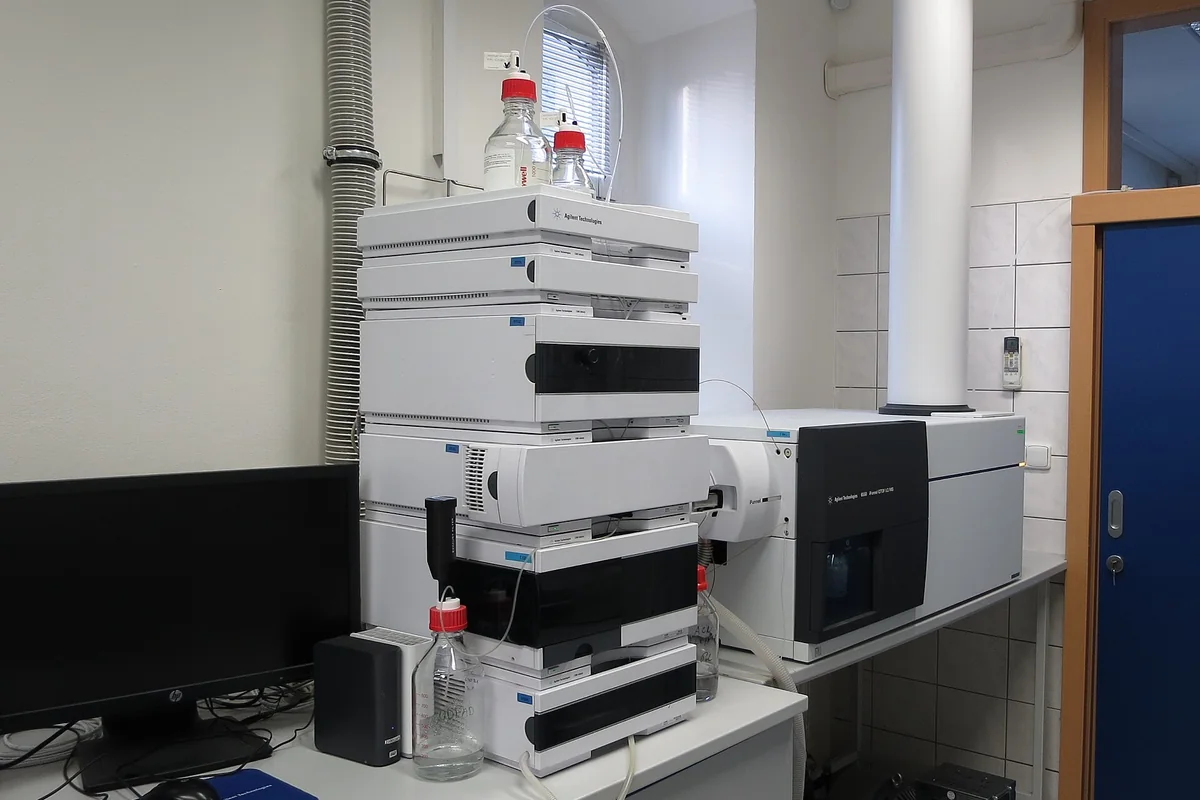
These are non-steroidal small molecules between roughly 290 and 530 daltons. They carry no amide backbone, so the 214 nm detection that underpins every peptide purity figure has nothing specific to detect and reports mostly solvent. Purity is measured at the compound's own ultraviolet maximum, established from the reference standard rather than assumed.
A molecule this size gives one singly charged ion, not the multiply charged envelope a peptide gives, so there is nothing to deconvolute and no charge series to report. What matters instead is polarity. The aryl propanamides carry cyano and nitro groups and respond in negative electrospray; the basic amines and the spiroindoline respond in positive. A screen run in one polarity is blind to part of its own compound list, and a non-detect from such a screen is not evidence of absence.
There is no counter-ion determination and no net peptide content, because neither concept applies. Content is assay against a certified reference standard, or where no standard for the compound exists, quantitative NMR against a certified standard of a different substance entirely.
| Question | For a peptide | For these compounds |
|---|---|---|
| Identity | Deconvoluted mass from a charge envelope | Single ion against a reference standard |
| Purity | Area at 214 nm | Area at the compound UV maximum |
| Content | Net peptide content by combustion | Assay against a standard, or qNMR |
| Mass balance | Counter-ion and water | Water and residual solvents |
| Stereochemistry | Rarely relevant | Decisive, and needs a chiral column |
Most of these compounds are supplied as a single enantiomer. An enantiomer has the identical molecular formula, the identical exact mass and the identical retention time on an achiral column, so a sample that is half the mirror image passes identity by mass spectrometry and reports high chromatographic purity at the same time. Nothing in a standard certificate registers it.
Enantiomeric purity is measured on a chiral stationary phase and on nothing else. It is a separate determination, developed per compound because a phase that resolves one aryl propanamide often fails on its neighbour, and validated with a racemic injection because a single enantiomer gives one peak whether or not the column is separating anything.
Where a certificate does not name a chiral phase, that question was not asked. Saying so is more useful than a purity figure that quietly excludes it.
The cheap compounds are substituted for the expensive ones, and the substitutes are frequently not modulators at all: a growth hormone secretagogue, a PPAR delta agonist and a REV-ERB agonist are among the substances most often found in products labelled as something else. Because they act on different receptors, they are grouped together only by marketing, and a method built around that grouping rather than around the chemistry misses them.
Isotope patterns do a large share of the work at no cost. A single chlorine gives the molecular ion a satellite two daltons up at about a third the height of the main peak, and two sulfurs give one at about nine percent. Compounds whose names differ by a single digit differ in whether that satellite exists, so its presence or absence excludes candidates before any standard is consulted.
The rest is mass. Two PPAR delta agonists in wide circulation differ by one aromatic fluorine, 18 daltons, which barely shifts reversed-phase retention and is unmistakable on a spectrum. Two REV-ERB agonists share an entire chromophore and fragmentation core and differ by 41 daltons. In both pairs, identity established from retention time has established nothing.
| Finding | Products | Share |
|---|---|---|
| Contained one or more modulators | 23 | 52 percent |
| Contained a different unapproved drug | 17 | 39 percent |
| Contained substances not on the label | 11 | 25 percent |
| No active compound detected | 4 | 9 percent |
| Amount matched the label | 18 | 41 percent |
Identity by mass spectrometry
Is the labelled compound actually present?
RP-HPLC-UVChromatographic purity
What fraction of the peptide-related material is the target?
Chiral HPLCEnantiomeric purity
Is the material the stated enantiomer, or its mirror image?
Karl FischerWater content
How much of the mass is water?
ICP-MSElemental impurities
Are there heavy metals, and at what concentration?
GC-MSResidual solvents
What is left over from synthesis and purification?
| Form | Amount |
|---|---|
| Raw powder | 30 mg in a sealed vial |
| Capsules or tablets | Ten units, unopened |
| Solution or suspension | 2 mL in the original container |
| Enantiomeric purity | 10 mg additional |
| Batch variance | Three or more units from one batch |
Turnaround is confirmed with the quotation. Microbiological determinations are governed by incubation and cannot be shortened by expediting.
How often is material sold in this category mislabelled?
In a chemical analysis of 44 products bought online and published in JAMA in 2017, only 52 percent contained any selective androgen receptor modulator, 39 percent contained a different unapproved drug, 9 percent contained no active compound at all, and the labelled amount matched the measured amount in only 41 percent.
Does a purity result show whether the right enantiomer was supplied?
No. Enantiomers co-elute as one peak on an achiral column and have identical masses, so material that is half the mirror image reports as pure. Enantiomeric purity requires a chiral stationary phase and is a separate determination.
Is MK-677 a selective androgen receptor modulator?
No. It is a growth hormone secretagogue acting at the ghrelin receptor. GW-501516 is a PPAR delta agonist and SR-9009 is a REV-ERB agonist. All three are sold in this category, none binds the androgen receptor, and each needs different ionisation conditions from the modulators themselves.
Can content be determined without a reference standard for the compound?
Yes, by quantitative NMR against a certified internal standard of a different substance, which gives an absolute mass fraction. It is the determination to order where no standard for the analyte is commercially available.
Why does the certificate state the ionisation polarity?
Because this class spans compounds that respond in opposite polarities. A screen acquired in one mode is blind to part of its own list, so a non-detect is only interpretable if the polarity used is stated.
Sources
- Chemical Composition and Labeling of Substances Marketed as Selective Androgen Receptor Modulators and Sold via the Internet. JAMA, 2017. PMID 29183075
- Specific characterization of non-steroidal selective androgen receptor modulators using supercritical fluid chromatography coupled to ion-mobility mass spectrometry. Drug Testing and Analysis, 2017. PMID 26990774
- Application of predicted fragmentation pathways and fragment ion structures for detecting steroids and selective androgen receptor modulators in dietary supplements using LC-QTOF-MS. Rapid Communications in Mass Spectrometry, 2022. PMID 35178795
- Importance of purity evaluation and the potential of quantitative proton NMR as a purity assay. Journal of Medicinal Chemistry, 2014. PMID 25295852
- ICH Q6A, Specifications for New Drug Substances and Products
Updated 2026-09-01