Testing / Cosmetic actives
Cosmetic actives
Active concentration, preservative efficacy inputs, metals and microbiological quality
| Brands verifying that a contract manufacturer delivered the declared active level |
| Formulators confirming active survives the formulation and its shelf life |
| Importers checking compliance of finished cosmetic products |
Cosmetic testing centres on whether the declared active is present at the declared concentration in the finished formulation, and whether the product is microbiologically sound over its claimed life. Peptide actives such as copper tripeptide and acetyl hexapeptide are quantified by LC-MS against a standard, because the concentrations involved are low and formulation matrices interfere heavily with ultraviolet detection.
Cosmetic actives are typically present at fractions of a percent, inside emulsions loaded with surfactants, polymers, humectants and preservatives. Ultraviolet detection is rarely specific enough in that environment, so quantitation is by liquid chromatography with mass spectrometric detection, monitoring a transition unique to the analyte.
Extraction is the harder half of the problem. Recovery from an emulsion has to be demonstrated on that formulation rather than assumed from a solvent standard, which means spiked recovery at the working concentration as part of the determination, not as an optional extra.
Copper tripeptide raises an additional wrinkle: the complex can dissociate during extraction, so the result depends on whether the method measures the intact complex or free peptide. The certificate states which.
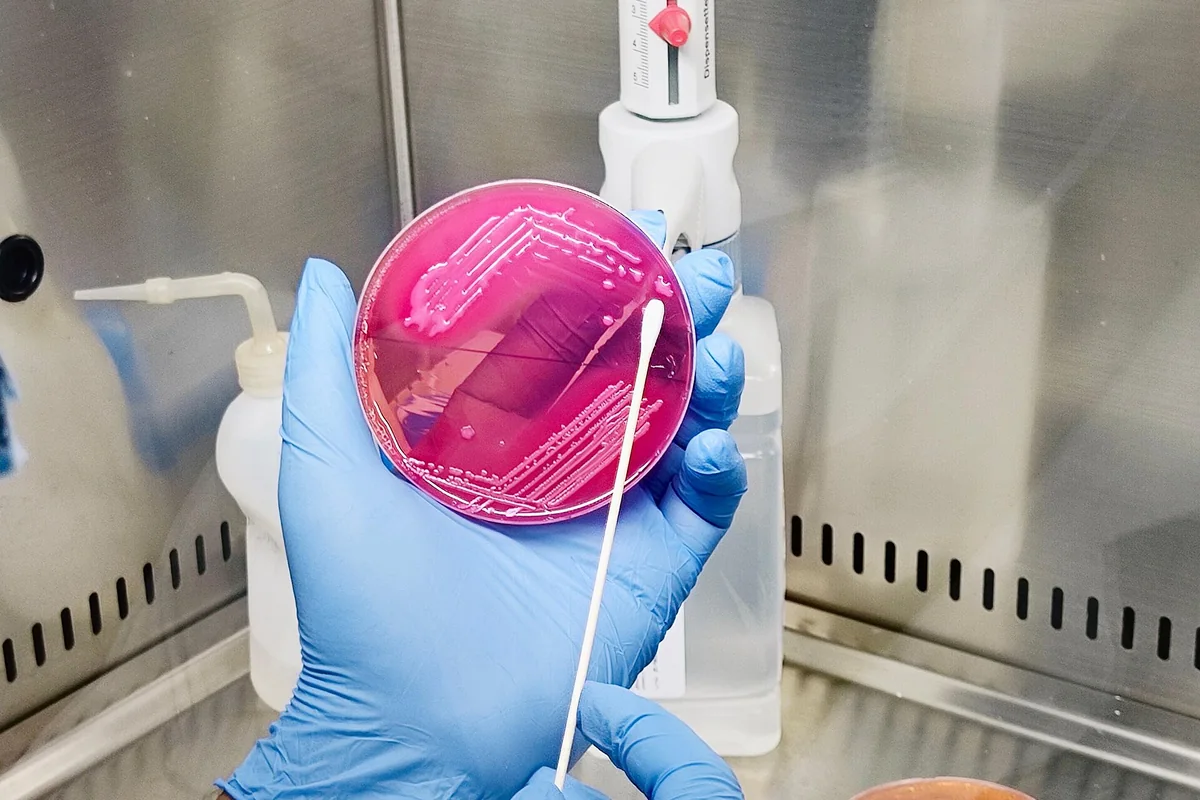
Finished cosmetics are non-sterile products with a bioburden specification. Enumeration under USP <61>, or the corresponding ISO methods, gives counts, and specified organism testing covers Pseudomonas aeruginosa, Staphylococcus aureus and Candida albicans, which are the organisms of concern for products applied to skin.
Preservative efficacy is a separate, longer study in which the product is deliberately inoculated and the decline in viable count is followed over 28 days. It answers whether the preservative system works over the product's life, and no enumeration result substitutes for it.
Water activity underpins both. A low water activity product is intrinsically resistant to microbial growth, and interpreting counts without knowing it leads to the wrong conclusion in both directions.
| Determination | Question | Duration |
|---|---|---|
| Active by LC-MS | Is the declared concentration present | Standard |
| Spiked recovery | Does extraction work in this matrix | Standard |
| USP <61> enumeration | What is the bioburden now | 5 to 7 days |
| Specified organisms | Are P. aeruginosa, S. aureus, C. albicans absent | 5 to 7 days |
| Preservative efficacy | Does preservation hold over shelf life | 28 days |
| Elemental impurities | Metals from pigments and raw materials | Standard |
Colour cosmetics carry a specific elemental risk because mineral pigments and lakes are inorganic by nature and can carry lead, arsenic and cadmium as manufacturing impurities. Determination is by ICP-MS after digestion, and the pigment fraction is usually where any finding originates.
Titanium dioxide and iron oxides are themselves elements of interest in a screen, and distinguishing an intended pigment from an unintended impurity is a matter of reading the result against the formulation rather than against a generic limit table.
| Form | Amount |
|---|---|
| Finished cosmetic | 50 g or two retail units |
| Raw active | 1 g |
| Microbiology | Two additional unopened units |
| Preservative efficacy | 150 g, unopened |
Turnaround is confirmed with the quotation. Microbiological determinations are governed by incubation and cannot be shortened by expediting.
Why is LC-MS used instead of HPLC-UV for cosmetic actives?
Because actives sit at fractions of a percent inside complex emulsions where ultraviolet detection lacks specificity. Mass spectrometric detection monitors a transition unique to the analyte and is not confused by the matrix.
Is preservative efficacy testing the same as microbial enumeration?
No. Enumeration counts what is present today. Preservative efficacy deliberately inoculates the product and follows the decline in viable count over 28 days, answering whether preservation holds across shelf life.
Do cosmetic products need heavy metal testing?
Colour cosmetics in particular, because mineral pigments and lakes can carry lead, arsenic and cadmium as manufacturing impurities. Determination is by ICP-MS after digestion.
Updated 2026-09-01